
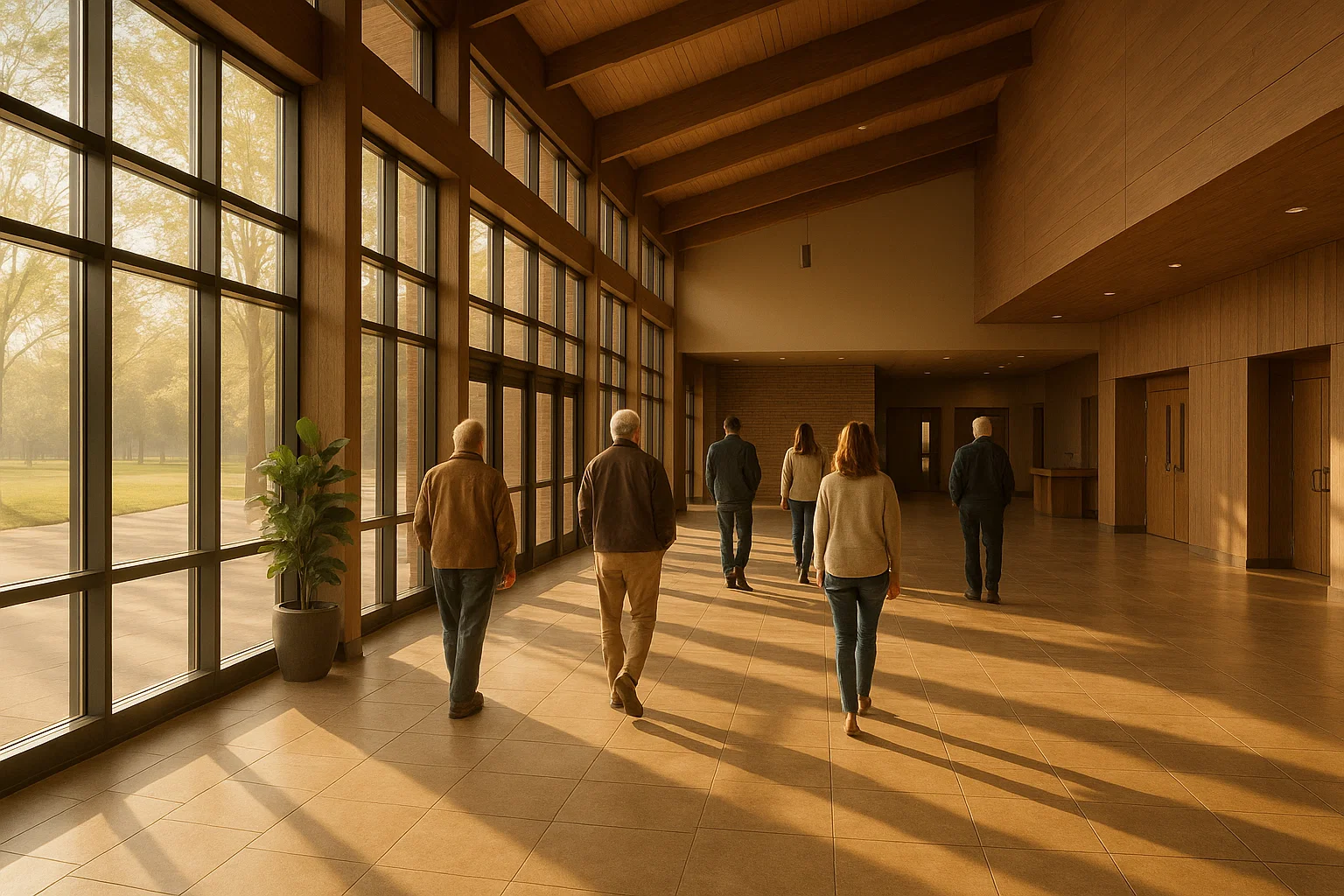
 Here’s where we settle in and talk it through like two people trying to understand a place that carries a lot of stories, questions, and mixed emotions. Calvary Church on East Beltline in Grand Rapids has been part of the local landscape for a long time, and whenever a church has that kind of history, people naturally carry their own curiosities. Some want clarity. Some want reassurance. Some just want to feel out whether it’s the kind of community where they’d be seen without having to hide parts of their life.
Let’s ease into it slowly instead of trying to sort everything at once.
A place with many doors depending on how someone walks in
If you’ve driven past the building, you know how big it is. And big churches tend to stir mixed feelings. Some folks love the energy; others feel a little lost, like they’re stepping into something already in motion. What I’ve noticed over the years is that the way a church feels isn’t just about its size. It’s about how it carries itself. The tone. The posture. The way people talk to each other before and after worship.
Calvary Church East Beltline sits in that interesting space between traditional roots and the shifting conversations happening in the broader Christian world. You can sense it if you watch how people interact warm greetings, polite nods, a little small talk about life in Grand Rapids. There’s a kind of Midwest steadiness there.
But steadiness doesn’t always answer the deeper questions people bring.
“Is Calvary Church LGBTQ friendly?”
This is usually asked quietly, sometimes whispered, almost always with emotion behind it. Not necessarily fear sometimes just longing for a place that won’t turn someone’s heart into a theological debate.
Most large evangelical churches, including Calvary, lean toward traditional teaching on sexuality and marriage. That shapes the official stance. But what people truly mean by “friendly” isn’t usually about doctrine; it’s about posture. Will someone be treated with dignity? Can they sit in a pew without feeling like the spotlight is on them? Will leaders actually listen instead of rushing to explanations?
I’ve seen people come through Calvary’s doors who didn’t fit the expected mold, and no one hovered over them. That doesn’t answer everything, of course. It just means there’s a difference between a doctrinal line and the human way a church holds it.
For some, that distinction matters deeply. For others, it isn’t enough. And that’s part of the tension many churches are quietly navigating how to hold to what they believe without losing the warmth Jesus showed to those who weren’t always welcomed by religious circles.
“What denomination is Calvary Church in Grand Rapids?”
This one comes up from folks who want to know what they’re stepping into theologically. Calvary identifies as a non-denominational evangelical church, which can feel both familiar and vague depending on your background. The teaching style leans strongly Bible-centered, but it’s not tied to a formal denominational structure like Baptist, Presbyterian, or Methodist.
That independence gives the church room to shape its own culture, but it also means leadership carries a lot of responsibility for guiding the direction and tone. Non-denominational churches tend to reflect their pastors more than their labels, and Calvary is no exception. People often get a sense of the church’s identity simply by listening to how the Scriptures are handled on a Sunday morning.
Questions about women in leadership tend to surface next
“Does Calvary Chapel allow female pastors?”
This is where things get easily tangled, mainly because the name Calvary can mean different things depending on the region. Calvary Chapel is a distinct movement with its own positions. Calvary Church on East Beltline is not formally part of the Calvary Chapel network.
Still, people ask because they’re trying to understand how leadership works.
From what’s been publicly shared over the years, Calvary Church teaches a complementarian model that’s a church structure where pastoral roles are reserved for men. Women serve in many areas, teach, lead ministries, and shape the community, but not typically under the title “pastor.”
This is another one of those topics that sits at the intersection of Scripture, culture, and lived experience. Some long-time members appreciate the clarity. Newcomers sometimes wrestle with it. And in-between all of that are good people trying to make sense of what faithfulness looks like in modern life.
“Is Skip Heitzig still a pastor?”
His name pops up because people associate “Calvary” with well-known pastors from similar-sounding churches. Skip Heitzig pastors in Albuquerque, not in Grand Rapids. He continues his ministry there, but his leadership has no direct connection to the East Beltline congregation.
Church names overlap, and it’s easy to mix them up especially when searching online. But Calvary Church in Grand Rapids has its own pastoral team, shaped by the community and history of this particular place.
What it actually feels like to be in the building
Sometimes the formal details don’t answer what someone is really trying to figure out: Would I feel like I belong there?
The worship style is modern without being flashy. The sermons tend to be structured but personal enough that people lean in. You’ll find folks who’ve attended for decades sitting right next to young families who moved to Grand Rapids last year.
There’s a rhythm to the place on a Sunday morning kids tugging on parents’ hands, volunteers carrying coffee urns across the lobby, people greeting each other with a familiarity that tells you they’ve been in each other’s lives longer than a simple handshake.
And woven through all of that is the quiet hope many bring with them: a desire for direction, connection, maybe even healing.
Some people arrive with questions about theology; others arrive with questions about life
Churches tend to meet both at the same pace. One step at a time. You can tell a lot about a church not by its official documents but by how people look after service lingering conversations, small clusters forming near hallways, someone standing alone for a moment before another person decides to walk over.
I’ve seen this at Calvary. Not perfectly, not dramatically just ordinary, human interactions that carry a sense of care.
But like any church, it has its limits and its blind spots. No congregation gets everything right. People who visit often sense both parts: the warmth and the unanswered questions.
Scripture has a way of softening the edges
There’s a verse in Romans that often comes to mind when people are trying to understand a church:
“Welcome one another as Christ has welcomed you.” (Romans 15:7)
It doesn’t define who qualifies or what background they need. It just points toward a posture. A heart turned outward, not inward.
Most churches, including Calvary on East Beltline, are trying sometimes awkwardly, sometimes beautifully to live somewhere near that idea.
Grand Rapids is full of church traditions, and people want clarity
Some carry past wounds. Others carry a lot of hope. Many simply want to know whether a church will hold space for honest questions without brushing them aside.
Calvary Church sits in the middle of that landscape steady, familiar, shaped by Scripture, cautious about cultural shifts, yet made up of real people who laugh, worry, pray, and try again each week.
If you walk in on a Sunday, you’ll likely notice that. Not in the polished parts, but in the small ones the way someone holds a door, or asks about your week, or makes room in a pew without making a fuss.
Those moments reveal more about a church than any doctrinal summary ever could.
A quiet closing thought
Every church has a personality. Calvary’s is shaped by tradition, Scripture, and the lived experiences of the people who call it home. Some will find deep comfort there. Others may wish for a different approach or a broader embrace.
And that’s alright. Faith journeys aren’t identical; they’re threads woven in different directions. But if you’re looking for a place in Grand Rapids where you can sit, listen, and sense the steady hum of a community trying to honor God as best it knows how, East Beltline’s Calvary Church has been that kind of place for many years.
Not perfect. Not everything to everyone. But earnest in its way and sometimes, that’s enough to begin.
Pastor Samuel Reed has served for over 20 years as a community pastor and counselor. He writes with kindness and wisdom, guiding readers to live out faith, forgiveness, and hope through God’s Word.