
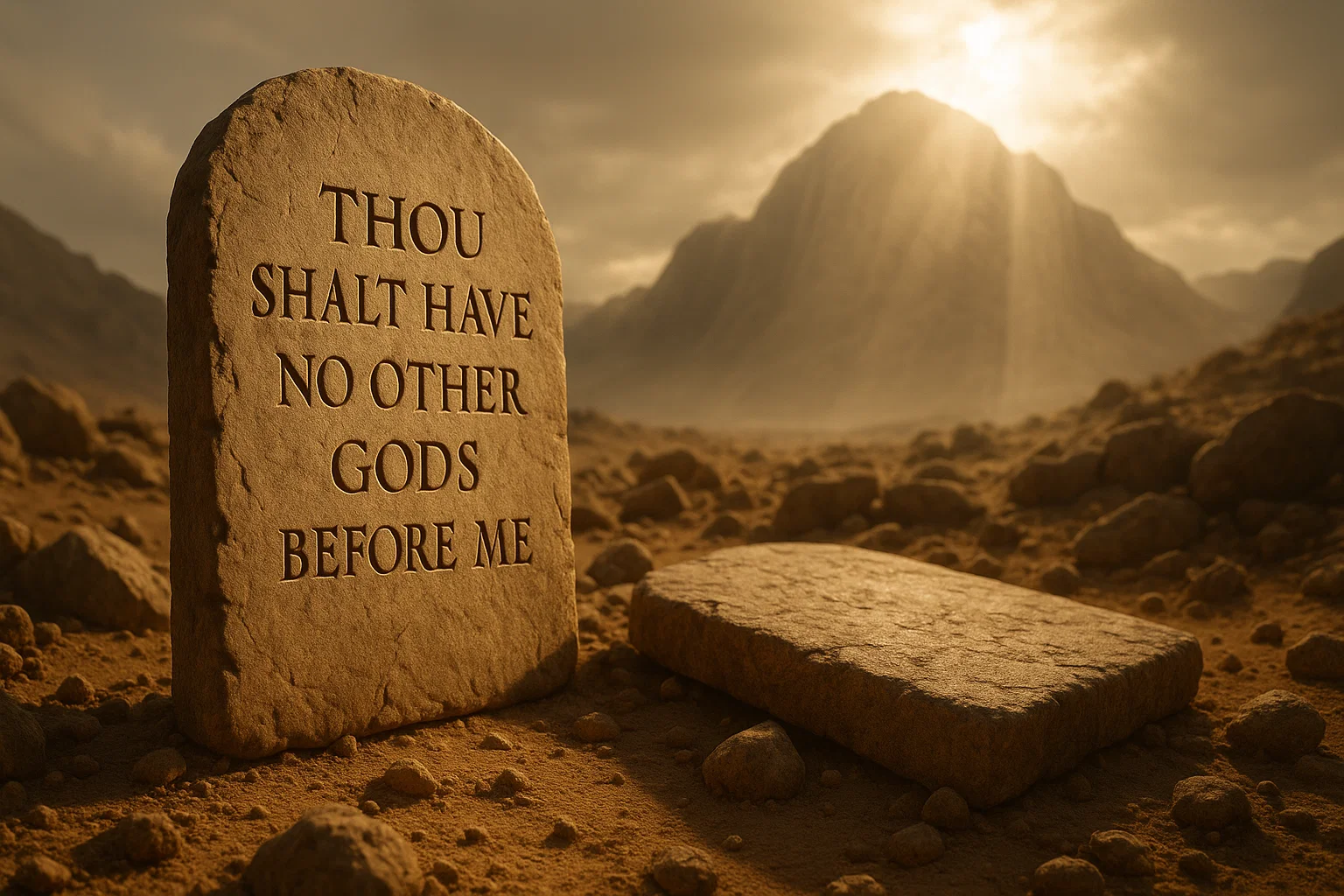
The Call for a Heart Fully Devoted to God
The first words etched on the tablets at Sinai still echo through time:
“You shall have no other gods before Me.” (Exodus 20:3)
In those eight words, God laid the foundation for all moral and spiritual order. Long before religions multiplied or cultures defined right and wrong, God revealed that true life begins with loyalty a heart that bows to Him alone.
For modern believers, this commandment isn’t just an ancient prohibition; it’s an invitation to real relationship. It asks a timeless question: Who or what rules your heart today?
What the First Commandment Really Means
At first glance, the command seems simple: don’t worship other gods. But in Hebrew, the phrase carries deeper layers.
The expression “before Me” (Hebrew lĕpānāy) literally means “in My presence” not just “ahead of Me,” but “in addition to Me.” God was saying:
“Do not place anything or anyone alongside Me as a rival for your devotion.”
In the polytheistic world of ancient Egypt and Canaan, this was revolutionary. Every nation served multiple deities: one for harvest, another for rain, another for fertility or war. But the God of Israel, YHWH, declared Himself singular and sovereign. His people were to worship no other presence, visible or invisible.
That remains the essence of faith not mere belief in God’s existence but exclusive trust and allegiance.
Historical Context: When God Spoke at Sinai
Picture the scene: the Israelites had just been freed from Egypt’s chains. They stood trembling at Mount Sinai, thunder rolling, lightning flashing, smoke filling the sky. For generations they had lived among idols and temples built for false gods.
Then God spoke directly: “I am the LORD your God, who brought you out of Egypt, out of the land of slavery.” (Exodus 20:2)
Only after reminding them of His saving power did He issue the first command.
This wasn’t a random rule; it was the response to a relationship already formed.
He was saying, “I rescued you. Don’t forget Me. Don’t replace Me.”
Through this commandment, God wasn’t protecting His ego He was protecting His people from the emptiness of idol worship that enslaves the soul.
“Thou Shalt Have No Other Gods Before Me” What It Means Today
We may not carve idols from stone or wood anymore, yet our hearts still build invisible altars.
Money, success, relationships, reputation, technology any of these can quietly take the first place in our lives.
“Whatever captures your ultimate trust and affection becomes your god.”
The first commandment therefore asks us to look honestly at what we love most.
Is it the God who saves, or something that merely satisfies for a moment?
Jesus echoed this same principle when He said, “No one can serve two masters.” (Matthew 6:24) we either give our loyalty to God or we divide it until faith grows cold.
Joshua 24:14-15 Choose Whom You Will Serve
Centuries after Sinai, Joshua stood before Israel with a similar challenge:
“Now therefore fear the Lord and serve Him in sincerity and truth… Choose this day whom you will serve… But as for me and my house, we will serve the Lord.” (Joshua 24:14-15)
Joshua understood what the first commandment required a conscious decision, not an emotional impulse.
Serving the Lord isn’t automatic; it’s renewed daily. Every believer must decide whom to follow when culture pulls in different directions.
Joshua’s words echo across time: Whom will you serve today?
The Ten Commandments in Order
To see where this command fits, here’s a brief summary of the Ten Commandments (Exodus 20 / Deuteronomy 5):
| No. | Commandment Summary | Focus |
|---|---|---|
| 1 | You shall have no other gods before Me | Worship |
| 2 | You shall not make idols or bow to them | Purity |
| 3 | You shall not misuse the name of the Lord | Reverence |
| 4 | Remember the Sabbath day, keep it holy | Rest |
| 5 | Honor your father and mother | Respect |
| 6 | You shall not murder | Life |
| 7 | You shall not commit adultery | Faithfulness |
| 8 | You shall not steal | Integrity |
| 9 | You shall not bear false witness | Truth |
| 10 | You shall not covet | Contentment |
Notice that the very first command establishes the foundation. Without exclusive worship of God, the rest lose their meaning.
True obedience begins with right worship.
Why God Demands Exclusive Devotion
God’s call for exclusive worship isn’t about control it’s about covenant love.
When He says “no other gods”, He’s calling His people to intimacy, not distance.
Think of it like a marriage: fidelity is essential for love to flourish.
Likewise, spiritual faithfulness sustains our walk with God.
When our loyalty is divided, our peace and purpose fragment too.
But when we honor God alone, our priorities, relationships, and identity align under His guidance.
How to Guard Your Heart Against Modern Idols
Here are a few ways to live the first commandment daily:
- Start your day acknowledging God first.
Before reaching for your phone or plans, give Him thanks. - Check where your trust lies.
Ask yourself, “If this were taken from me, would my peace disappear?”
If yes, that thing might have become an idol. - Replace pride with prayer.
Pride whispers, “You’re enough on your own.” Prayer reminds, “God is enough.” - Worship through obedience, not just words.
Real worship isn’t confined to singing; it’s reflected in decisions, compassion, and truthfulness. - Remember His deliverance.
Just as Israel was freed from Egypt, you’ve been freed from sin don’t return to what enslaved you.
What This Teaches Us About Faith
“Thou shalt have no other gods” is more than commandment #1 it’s the heartbeat of Scripture.
Every prophet, every psalm, every teaching of Jesus flows from this truth:
God alone is worthy of our worship.
When life feels divided, this verse centers us again.
It reminds us that peace doesn’t come from having more, but from loving One above all.
As Joshua declared long ago, “As for me and my house, we will serve the Lord.”
May that declaration become ours not only in words but in how we live, think, and choose each day.

Dr. Elias Johnstone is a theologian and church historian with deep insight into biblical doctrine. He helps readers see how God’s truth connects through Scripture, bringing faith to life with meaning and depth.