
 The life of Jesus of Nazareth remains the most studied and discussed story in human history. Yet between the moment when the twelve-year-old Jesus amazed the teachers in the Temple and the day He appeared at the Jordan River to be baptized by John, the Gospels fall silent. Nearly two decades vanish from the record. Scripture moves from childhood wonder to messianic mission with no transition. These “hidden years” invite both curiosity and faith.
What do we really know and why might the Bible choose silence?
What Are the Unknown Years of Jesus’ Life?
Luke offers the clearest boundary: after recounting the boy Jesus in the Temple, he writes, “And Jesus increased in wisdom and stature, and in favor with God and man.” (Luke 2:52)
The next verse in the narrative leaps forward almost eighteen years to the baptism in the Jordan (Luke 3:21-23).
Those years roughly from ages 12 to 30 are the unknown years. The New Testament gives no detail of where Jesus traveled, what He studied, or how He lived. Yet the simplicity of Luke’s summary verse hints that His growth was steady, ordinary, and holy.
Many scholars see Luke 2:52 as a theological bridge. It shows that divine calling unfolded through human formation: wisdom (mental), stature (physical), favor with God (spiritual), and favor with man (social). In other words, the Son of God matured as the Son of Man.
Why the Bible Is Silent About Jesus’ Early Life
Silence in Scripture is rarely accidental. The biblical writers were not compiling biographies; they were proclaiming good news. Each Gospel selects events that reveal Christ’s identity and mission, not every stage of His upbringing.
John 21:25 admits as much: “If every one of the things Jesus did were written down, I suppose that even the whole world would not have room for the books that would be written.”
By omitting the ordinary years, the evangelists emphasize that Jesus’ purpose was divine redemption, not human curiosity. The focus is theological, not biographical. The hidden years protect mystery they keep attention on the message of salvation rather than the mechanics of His youth.
Historically, first-century readers would not have expected a full biography. Ancient “lives” of great teachers or prophets commonly skipped early periods unless they illustrated later virtue. Thus, biblical silence fits both literary and theological convention.
Historical Clues and Cultural Context
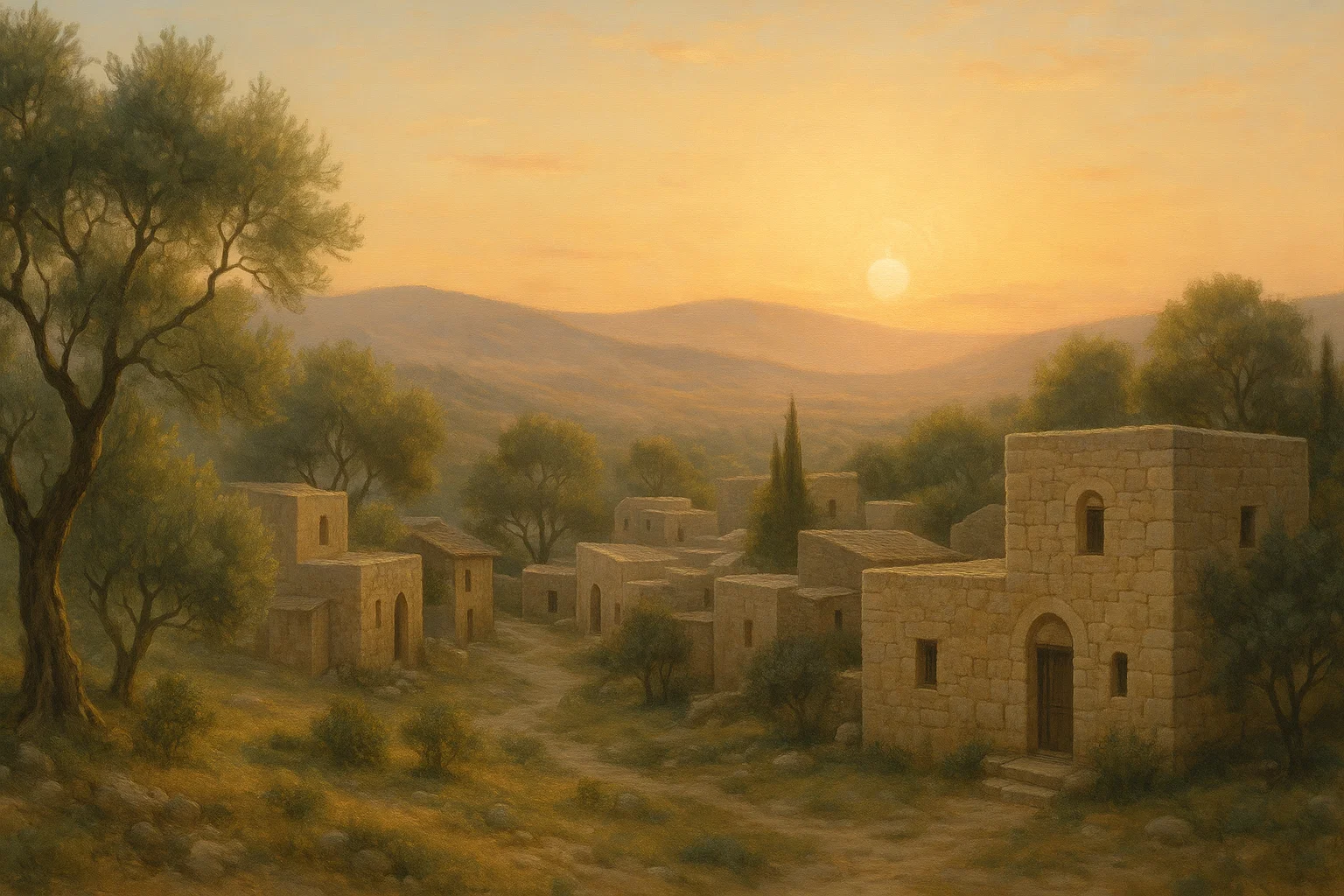
Although Scripture is quiet, history and archaeology paint a setting. Nazareth in Galilee was a small agricultural village, perhaps two hundred inhabitants, nestled among limestone hills. Excavations reveal stone workshops, wine-presses, and terraces of olives and figs ordinary life in Roman-era Judea.
As the son of Joseph the carpenter, Jesus likely worked in manual labor. The Greek word tekton implies a craftsman skilled in wood and stone someone who built farm tools, doors, or small structures. This trade required patience and strength, virtues later mirrored in His teaching about endurance and foundation (Matthew 7:24-27).
Religiously, Galilean boys memorized Torah passages and attended synagogue instruction. By age twelve, Jesus had demonstrated exceptional understanding of Scripture. It is reasonable to believe He continued deep study and prayer within His local community. Nothing sensational just faithful preparation.
Jewish Customs and Family Life in Nazareth
Jewish families in the first century practiced rhythms that shaped moral and spiritual character: morning prayers, Sabbath rest, annual pilgrimages, and communal feasts. These patterns trained young men to integrate faith into daily work.
When Luke says Jesus “was subject to” His parents (Luke 2:51), it underscores obedience as spiritual discipline. Long before public miracles, Jesus honored divine law in private life. The hidden years thus become years of obedience the school of humility before the mission of glory.
Early Christian Traditions and Extra-Biblical Texts
By the second and third centuries, curiosity about Jesus’ youth produced imaginative writings such as the Infancy Gospel of Thomas or the Arabic Gospel of the Infancy. These non-canonical texts describe the child Jesus forming birds from clay or striking playmates dead and reviving them.
The Church never accepted these stories as Scripture. They conflict with the moral portrait preserved in the canonical Gospels. Yet their very existence proves how strongly believers longed to fill the gap.
Historically reliable clues remain scarce. Church Fathers like Justin Martyr and Irenaeus assume Jesus stayed in Nazareth until His baptism. None suggest travel beyond Palestine.
Thus, the simplest answer still stands: He lived quietly, matured in wisdom, and awaited the appointed hour.
Myths and Speculations About the Missing Years
Throughout modern history, writers have proposed exotic theories: that Jesus journeyed to India to study with Hindu sages, that He joined the Essenes near Qumran, or that He traveled to Britain with Joseph of Arimathea. None of these claims are supported by credible historical evidence.
Scholars note that no contemporary record, Jewish or Roman, mentions such travels. The Gospels identify Jesus as “Jesus of Nazareth” a title implying consistent residence. His hometown was well known to neighbors who later asked, “Is not this the carpenter’s son?” (Matthew 13:55).
The persistence of these myths reveals something about human nature: when mystery meets silence, imagination fills the gap. Yet faith calls us to trust what God chose to reveal and accept what He chose to withhold.
Do We Have DNA of Jesus?
From time to time, media headlines claim that scientists have found DNA traces on relics the Shroud of Turin, the Sudarium of Oviedo, or ancient ossuaries bearing names like “Jesus son of Joseph.”
While these artifacts are historically intriguing, none can be verified as belonging to Jesus of Nazareth. Even if biological material were available, confirming divine identity by genetics would contradict the very nature of the Incarnation.
Christian belief rests not on DNA but on resurrection. As Paul wrote, “If Christ has not been raised, our faith is in vain.” (1 Corinthians 15:14) The power of Jesus’ life does not reside in strands of physical code but in the living Spirit that transforms hearts.
What Was Jesus Doing Before His Public Ministry?
Between childhood and baptism, Jesus likely worked alongside Joseph until Joseph’s death, supporting His family. The absence of Joseph in later narratives implies Jesus became the household’s provider.
This period shaped His empathy for ordinary laborers and the poor. Later parables about sowers, merchants, and builders show firsthand knowledge of trades and daily struggles. God’s Son entered fully into the fabric of human life not as a distant deity but as one who understood calloused hands and weary evenings.
Such hidden years model divine patience: thirty years of preparation for three years of ministry.
The Hidden Life as Preparation for Mission
When the heavens finally opened at His baptism, the Father declared, “You are My beloved Son; in You I am well pleased.” (Luke 3:22)
Notice before a single sermon or miracle, the Father’s pleasure rested on His Son. The years of unseen faithfulness had already delighted Heaven.
In spiritual terms, hidden seasons test identity. Jesus did not need public acclaim to confirm divine approval. He learned obedience through ordinary days. Likewise, believers today grow most deeply when no audience watches when faithfulness replaces fame.
Lessons from the Carpenter’s Bench
The carpenter’s bench becomes a quiet classroom. Every measured cut, every repaired beam mirrored the discipline of patience. The man who would later be called the Cornerstone learned to square stones for earthly walls.
Early Church writers loved this symbolism. Justin Martyr described the wooden yokes and plows Jesus might have crafted tools of labor that foreshadowed His invitation: “Take My yoke upon you and learn from Me.” (Matthew 11:29)
Manual work sanctified time. It proved that holiness is not confined to temple courts but can dwell among sawdust and sweat.
The Theology of Divine Hiddenness
In theological reflection, the hidden years illustrate a pattern called divine hiddenness periods when God works invisibly yet purposefully. Scripture is full of such intervals: Moses’ forty years in Midian, David’s shepherd years before the throne, Paul’s years in Arabia before apostleship.
God forms character in obscurity. The silence surrounding Jesus’ youth is not absence but incubation. As Isaiah foretold, “He shall grow up before Him like a tender shoot.” (Isaiah 53:2) Growth happens quietly before revelation bursts into light.
Spiritual Meaning of God’s Silence
For modern believers, the blank space in Jesus’ biography becomes a mirror of our own seasons of waiting. There are times when heaven seems silent, when progress feels invisible. Yet in those unseen years, God fashions depth.
Just as Jesus’ preparation preceded His public calling, so our hidden obedience precedes our visible fruit. Holiness ripens slowly.
Faith, therefore, is not the absence of questions but the presence of trust amid them.
What About Claims of Jesus’ Wife or Daughter?
Popular fiction and sensational documentaries have speculated that Jesus married Mary Magdalene or had descendants. These ideas stem from misread Gnostic writings such as the Gospel of Philip and modern novels like The Da Vinci Code.
Canonical Scripture provides no hint that Jesus married or fathered children. His mission was singular: to fulfill divine redemption. He referred to Himself as the Bridegroom whose bride is the Church (Matthew 9:15).
The New Testament consistently portrays celibacy as part of His dedication to the Father’s will. Speculative genealogies distract from that sacred purpose.
Art and Cinema: How Movies Portray the Unknown Life
Filmmakers have long tried to visualize Jesus’ human journey. Productions such as Jesus of Nazareth (1977) and The Passion of the Christ (2004) focus on the public ministry and passion rather than the youth, precisely because the sources are sparse.
When art depicts the hidden years, it must imagine with reverence. The best portrayals convey moral tone rather than factual detail showing a young man shaped by prayer, family, and work.
Cinema reminds us that imagination can serve faith when guided by truth, not speculation.
Why the Unknown Life Matters for Doctrine
Doctrinally, the hidden years affirm the Incarnation’s completeness. Jesus did not merely appear adult; He passed through every human stage. The Epistle to the Hebrews says, “He learned obedience by the things which He suffered.” (Hebrews 5:8)
That learning began long before Calvary in the quiet classroom of Nazareth. Therefore He can sympathize with human growth, limitation, and endurance. The Savior who redeems time also sanctified time by living it fully.
Hidden Years and Modern Faith Formation
The church has sometimes overlooked the theology of growth. Modern culture prizes instant results, but spiritual maturity follows the rhythm of Jesus’ hidden life: study, labor, prayer, community, and patience.
For students, parents, and workers who wonder if their daily routines matter, the answer lies in Nazareth. God values steady faithfulness more than visible achievement. If the Son of God could spend three decades in quiet duty, no season of our life is wasted.
The Unknown Life as Invitation to Trust
In every generation, believers face questions Scripture does not fully answer. The missing details of Jesus’ youth teach us to rest in God’s wisdom. Mystery is not a flaw in revelation; it is a doorway to reverence.
When curiosity seeks control, faith responds with worship. The silence of Nazareth invites contemplation rather than speculation.
The Hidden Life Revealed Through Obedience
Luke 2:51 says, “Then He went down with them and came to Nazareth, and was subject to them.” This simple verse summarizes eighteen years of quiet submission. Before He calmed storms or healed the blind, Jesus obeyed earthly parents and divine timing.
Every miracle later performed flowed from the same heart of obedience practiced in obscurity. God often entrusts public responsibility only to those who have proven faithful in private.
Faith in the Silence: What This Teaches Us About Our Walk with God
When life feels uneventful, when our prayers seem unanswered, we stand in Nazareth with Jesus. Hidden seasons are not wasted; they are workshops of grace.
Spiritual maturity often grows in the soil of routine washing dishes, earning wages, caring for family, enduring delay. Through such tasks, we become participants in the pattern Christ set: preparation before proclamation, humility before glory.
Ultimately, the unknown years are not about absence but presence God quietly dwelling among us, shaping redemption one ordinary day at a time.
Closing Reflection
The Gospels open and close with divine light, but between Bethlehem’s star and Calvary’s cross stretches a long, quiet dawn. The silence is sacred. It reminds us that God’s greatest works often unfold unseen.
In our own hidden years whether studying, working, grieving, or waiting we can take comfort that the Redeemer once lived the same pattern.
What the Bible does not tell us about Jesus’ youth may be precisely what our faith needs to remember: that holiness can bloom in obscurity, and the unseen life can still change the world.

Dr. Elias Johnstone is a theologian and church historian with deep insight into biblical doctrine. He helps readers see how God’s truth connects through Scripture, bringing faith to life with meaning and depth.