The Sacred Ground of Remembrance
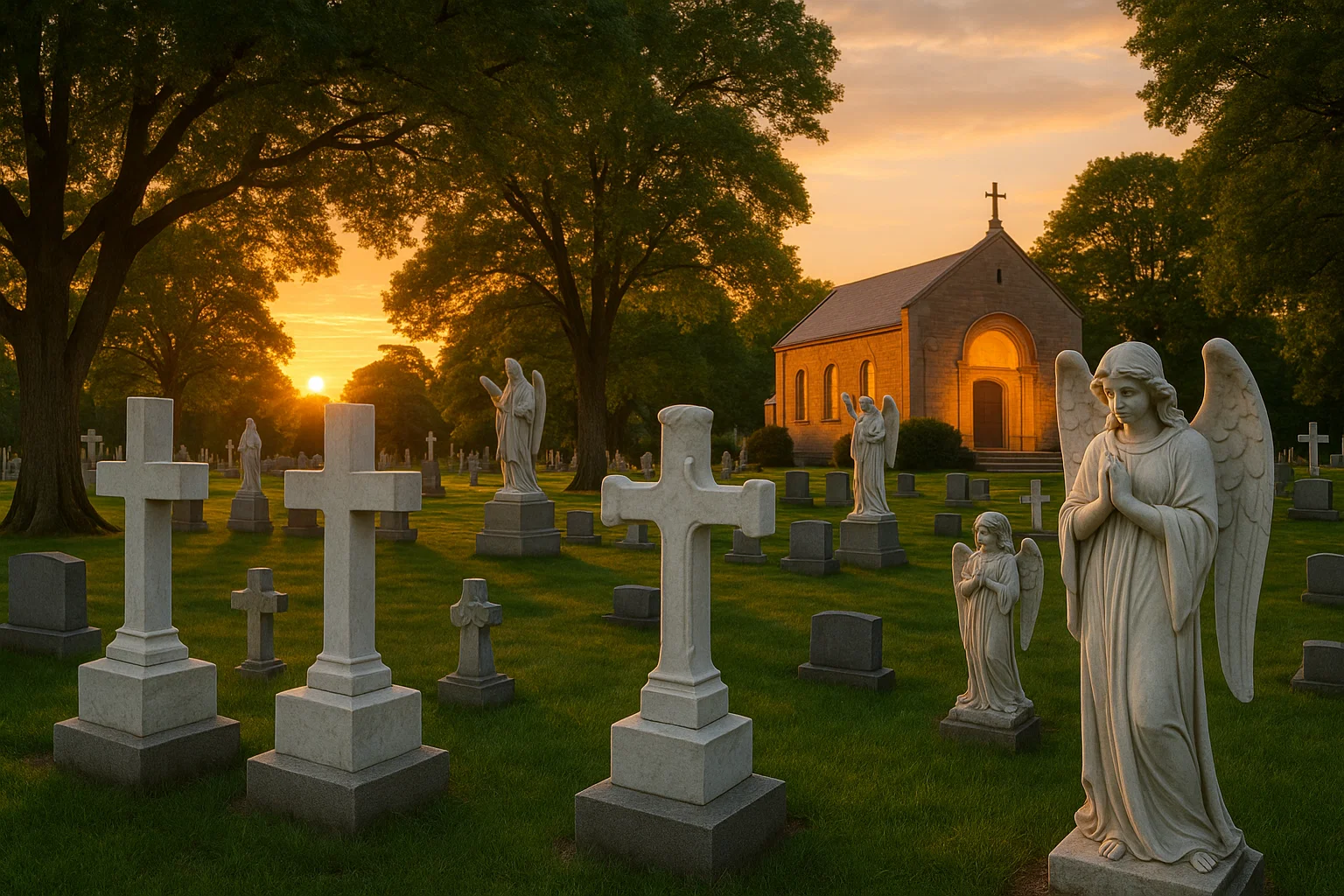
Just outside Philadelphia, in the quiet borough of Yeadon, Pennsylvania, lies a field of carved stone and deep faith. Holy Cross Cemetery is more than a burial ground; it is a testament to the Catholic conviction that death is not the end but the threshold of eternal life. Founded in 1890 by the Archdiocese of Philadelphia, the cemetery spreads over hundreds of peaceful acres, where winding paths, angel statues, and cruciform headstones tell stories of hope.
Every Catholic cemetery is, in essence, a proclamation of the Apostles’ Creed: “I believe in the resurrection of the body, and life everlasting.” From the earliest Christian catacombs to modern sanctuaries like Holy Cross, believers have sought to rest their bodies in consecrated soil as an expression of that faith. Burial is not simply a tradition it is a theological statement. The Church teaches that our bodies, once temples of the Holy Spirit (1 Corinthians 6:19), deserve reverent care even in death, awaiting the resurrection promised by Christ.
Holy Cross Cemetery stands among the most historic Catholic burial sites in Pennsylvania. It was established during a period when Philadelphia’s Catholic population was rapidly growing due to Irish, Italian, and Polish immigration. The faithful longed for a place that would honor both their cultural heritage and their spiritual identity. The cemetery quickly became a resting place for clergy, religious sisters, veterans, and ordinary believers whose quiet devotion built parishes across the region.
As one walks through the main entrance, the imposing bronze crucifix near the central chapel reminds visitors of St. Paul’s words: “For if we have been united with him in a death like his, we will certainly be united with him in a resurrection like his” (Romans 6:5). The entire landscape preaches that message without a sound.
Who Rests Beneath the Cross
Many ask, “What famous people are buried at Holy Cross Cemetery in Yeadon?” Among the nearly 200,000 souls interred there are several whose names echo beyond Philadelphia.
- Cardinal John O’Hara (1888 – 1960) former Archbishop of Philadelphia and later Cardinal of the Church. His leadership shaped Catholic education and social outreach in the mid-twentieth century.
- Jack Kelly Sr. (1889 – 1960) Olympic gold-medal rower, businessman, and father of actress Grace Kelly (later Princess Grace of Monaco). His life bridged faith, sport, and civic service.
- Grace Drayton (1877 – 1936) illustrator known for the “Campbell Soup Kids,” whose gentle artistry still charms American advertising history.
- Pat Kelly (1954 – 2005) professional baseball player for the Toronto Blue Jays and Chicago White Sox, remembered not only for his athletic skill but for his outspoken Christian testimony.
Yet for every public name, there are thousands known only to family and to God. The Church insists that each grave famous or forgotten holds infinite worth, because each person bears the image of the Creator (Genesis 1:27). In that way, Holy Cross Cemetery becomes a democratic field of grace: bishops lie beside bakers, artists beside accountants, all equal in the mercy of Christ.
Who Can and Cannot Be Buried in a Catholic Cemetery
Visitors often wonder, “Who can’t be buried in a Catholic cemetery?” The question touches on both theology and pastoral care.
Catholic canon law reserves consecrated burial for those who die in communion with the Church. Historically, those formally excommunicated, those who renounced the faith publicly, or those whose burial would cause scandal could be denied Catholic rites. Yet the Church’s heart is merciful. Modern pastoral guidelines emphasize reconciliation and the possibility of grace even at the final hour.
As the Catechism reminds us, “God alone is the judge of hearts” (CCC 1861). In practice, local bishops and pastors discern each case carefully. The focus is no longer exclusion but evangelization: even in death, the Church seeks to witness to Christ’s compassion. Holy Cross Cemetery embodies that spirit; its priests often meet with families from complex or mixed-faith backgrounds to provide comfort and clarity.
It is also worth noting that Catholic cemeteries now provide respectful accommodations for those cremated once a controversial practice. While early Christians opposed cremation because pagan cultures used it to deny bodily resurrection, the Church today permits it when chosen for practical reasons rather than disbelief. The key requirement is that cremated remains be treated with the same dignity as a body: placed in a proper urn, interred in sacred ground, and not scattered or kept at home.
So yes, Holy Cross does cremation, offering mausoleum niches and memorial walls designed for that purpose. In this way, tradition adapts without surrendering its theological center the hope of resurrection.
Finding Names, Finding Stories
Another common question is “How can I find a list of people buried at a cemetery?”
Holy Cross Cemetery participates in online databases such as Find a Grave and BillionGraves, where volunteers and staff record headstones and plot information. The Archdiocese of Philadelphia also maintains a Catholic Cemeteries Office that assists families in locating relatives. Yet digital tools only reveal names and dates. To truly find a person is to remember the story that name represents the laughter, struggles, and prayers that once filled their days.
For genealogists, Holy Cross Cemetery is a treasure trove of Catholic history. Parish records, baptismal certificates, and funeral registers often connect generations of immigrants who helped shape the moral and cultural backbone of the region. Researchers studying the growth of Catholic education or the labor movement in Pennsylvania frequently begin their work among these graves, where the social fabric of faith is literally written in stone.
But for pilgrims of faith, visiting the cemetery is less about data and more about devotion. Lighting a candle, whispering a prayer at a headstone, or simply walking in silence can awaken the profound communion of saints the mystical fellowship uniting the living and the dead in Christ. “Since we are surrounded by so great a cloud of witnesses…” (Hebrews 12:1). In Yeadon’s quiet air, one can almost sense that cloud drifting close.
Theology Beneath the Soil
What does it mean, theologically, to rest beneath a cross?
The Church views cemeteries as extensions of the altar. Every Mass, after all, recalls both the death and resurrection of Christ. In the Eucharist, the faithful are united with the same Savior whose cross crowns Holy Cross Cemetery. Thus burial in consecrated ground is sacramental in character it participates in the sanctifying presence of the Church.
Dr. Johnstone might remind his students that this practice flows directly from Scripture. Abraham purchased the Cave of Machpelah as a family burial site (Genesis 23), acknowledging both human mortality and divine promise. Joseph of Arimathea offered his own tomb for the body of Jesus, fulfilling prophecy that “He was with a rich man in his death” (Isaiah 53:9). Early Christians gathered in catacombs, celebrating the Eucharist beside the tombs of martyrs to express unity with them.
Holy Cross Cemetery continues that lineage. Its very soil, blessed by a bishop’s hand, declares that even the body laid here remains under God’s covenant. Death may claim the flesh, but grace holds the destiny.
Faith Meets Modern Life
Modern attitudes toward death often avoid permanence. Some prefer scattering ashes at sea or creating digital memorials instead of physical graves. While these gestures may feel freeing, the Church invites a different vision one grounded, literal, and hopeful. The burial ground becomes a sacred geography where memory and resurrection meet.
In Yeadon, the cemetery’s design still honors this theology. Each section named after saints or mysteries of the rosary offers a visual catechism. The Garden of Resurrection, for instance, features a marble statue of Christ rising from the tomb, arms open to the dawn. Families gather there on All Souls Day to pray for loved ones, reaffirming that the bond of love transcends mortality.
The upkeep of Holy Cross Cemetery also carries social meaning. Groundskeepers, many of whom are lifelong parishioners, see their work as ministry. They trim grass not merely for appearance but as an act of reverence. Their care preaches a silent homily: that beauty still matters, even in sorrow.
Comfort for the Living
For those who come to visit, grief often mingles with gratitude. Beneath the sigh of trees and the echo of church bells from nearby parishes, the visitor may recall Christ’s words: “Blessed are those who mourn, for they shall be comforted” (Matthew 5:4).
In Catholic understanding, mourning itself becomes a form of prayer. To weep beside a grave is to echo the compassion of Jesus who wept at Lazarus’s tomb (John 11:35). The cemetery, therefore, is not a place of despair but of dialogue between earth and heaven, between time and eternity.
Pastors frequently remind the bereaved that visiting a cemetery is a corporal work of mercy: “bury the dead.” But it is also spiritual an act of remembrance that strengthens faith in the communion of saints. As the liturgy for All Souls proclaims, “Indeed for your faithful, Lord, life is changed not ended.”
That simple sentence could serve as the motto of Holy Cross Cemetery Yeadon.
Lessons from Holy Cross for a Forgetful Age
In an era fascinated by instant news and short-term memory, places like Holy Cross challenge our pace. They invite us to pause, to consider legacy rather than immediacy. The rows of names remind us that each life, however ordinary, contributed a verse to the larger hymn of God’s story.
Visiting a cemetery may also rekindle moral reflection. How do we wish to be remembered? What faith are we handing to those who will one day stand at our graves? The philosopher-theologian Joseph Ratzinger (Pope Benedict XVI) once wrote that a cemetery is “a place where faith becomes geography.” That line captures Yeadon perfectly: theology written on the land itself.
A Reflection on Resurrection Hope
As dusk falls over the cemetery, the cross silhouettes against the orange sky. Birds settle into trees, and the marble seems to glow with its own quiet light. It is easy, in that stillness, to believe in resurrection.
The hope of the Christian is not mere survival but transformation. “We shall not all sleep, but we shall all be changed” (1 Corinthians 15:51). Burial in a place like Holy Cross Cemetery is therefore a declaration of trust: that God will remember every name carved in stone and call each one forth on the last day.
In this way, Holy Cross Cemetery Yeadon stands not only as a map of the past but as a signpost toward the future. Its silence preaches, its stones sing, and its cross points heavenward.
Practical Guidance for Visitors and Families
Those seeking to contact the Catholic Cemeteries Office of the Archdiocese of Philadelphia can request plot information, arrange new interments, or inquire about cremation services. The staff often assist families in planning liturgies or installing memorials consistent with Church norms.
Visitors are encouraged to follow reverent etiquette: keep voices low, avoid stepping on graves, and refrain from leaving secular decorations that distract from the sacred environment. Most importantly, they are invited to pray for the dead and for themselves that God’s mercy may unite all who rest and all who wait.
Closing Meditation
Holy Cross Cemetery Yeadon reminds us that Christianity does not separate doctrine from dust. The very ground becomes a confession of faith. Each stone whispers the same promise Christ gave Martha at her brother’s tomb:
“I am the resurrection and the life; whoever believes in Me, though he die, yet shall he live” (John 11:25).
For those who believe, that verse is not carved merely on marble but on the heart. The cemetery’s silence is not emptiness; it is expectation. And somewhere beneath those peaceful trees, the earth itself seems to wait for the trumpet sound of glory.
Dr. Elias Johnstone is a theologian and church historian with deep insight into biblical doctrine. He helps readers see how God’s truth connects through Scripture, bringing faith to life with meaning and depth.