
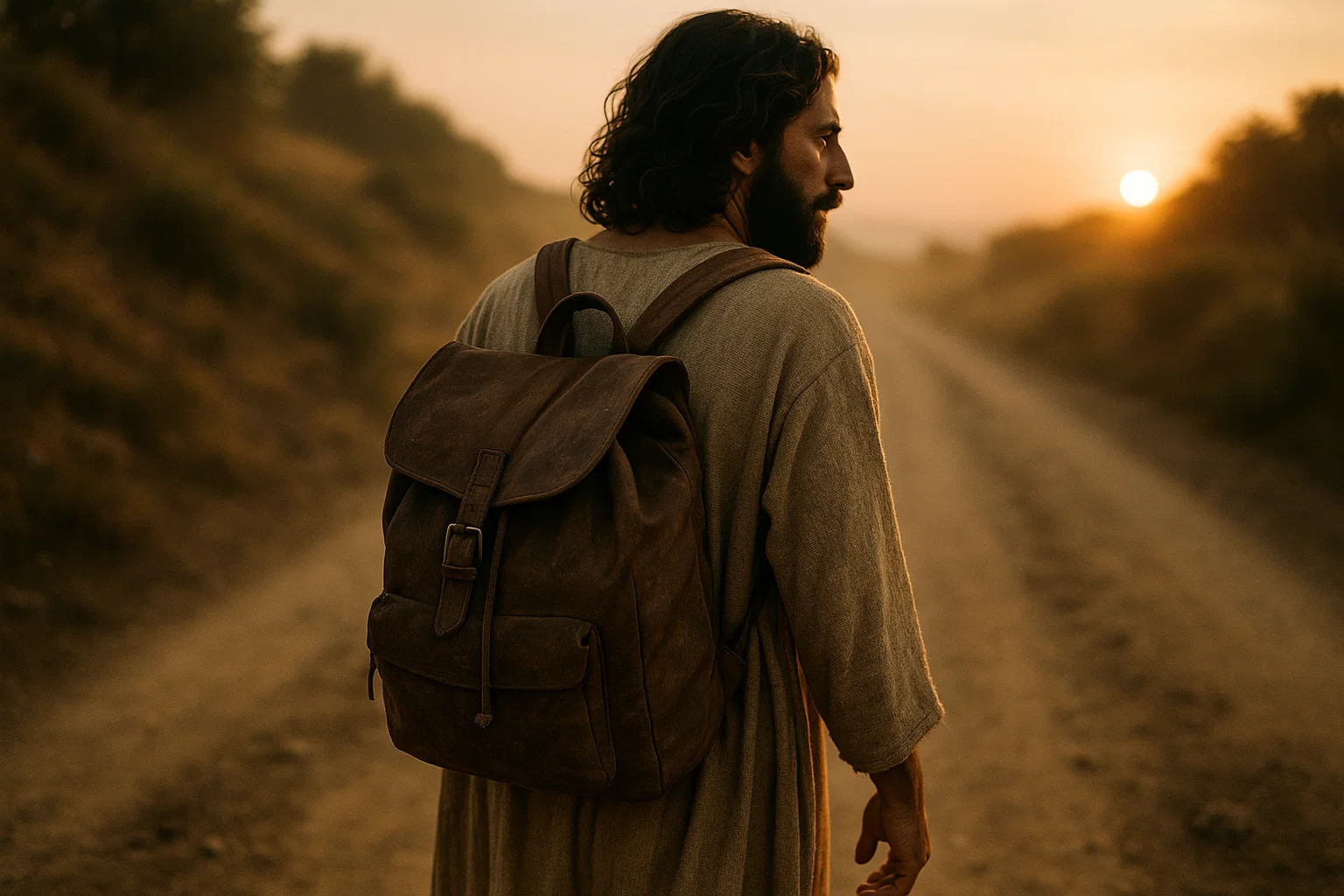
 When The Chosen first appeared on screens, it invited viewers to see Jesus through human eyes walking dusty roads, laughing with His friends, and meeting broken people with compassion.
Yet one small detail has stirred a surprisingly big conversation: the backpack Jesus wears.
Why does the Son of God, who told His disciples to travel light, carry a bag?
Is it historically accurate or merely artistic imagination?
And does it change how we understand Christ?
Let’s walk the road together and unpack quite literally what this simple object might mean for faith, art, and biblical accuracy.
Why Does Jesus Have a Backpack in The Chosen?
If you’ve watched the early episodes, you’ll notice Jesus wearing a humble, hand-stitched leather satchel.
The show’s director, Dallas Jenkins, has explained that small props like this help humanize biblical figures without changing Scripture’s message.
The backpack isn’t a theological statement; it’s a storytelling tool.
In first-century Judea, travelers routinely carried a small leather bag or cloth pouch to hold bread, tools, or a water flask.
The Gospels show Jesus and His disciples walking from village to village (Luke 8:1, Matthew 9:35).
These were long, hot journeys up to 20 miles a day through rugged terrain.
So, a simple travel bag wasn’t far-fetched.
In The Chosen, that backpack serves a cinematic purpose: it reminds viewers that Jesus walked as a man, feeling hunger, dust, and fatigue.
It visualizes the reality of the Incarnation “The Word became flesh and dwelt among us” (John 1:14).
Far from diminishing His divinity, it makes His humanity tangible.
The Backpack as a Symbol of Human Journey and Burden
Beyond historical realism, the backpack also carries symbolic meaning.
Think about how Scripture speaks of burdens:
“Come to Me, all you who labor and are heavy laden, and I will give you rest.” Matthew 11:28-30
When we see Jesus carrying a pack, it mirrors that verse in reverse the One who offers rest chooses to carry the weight Himself.
It’s a visual parable of empathy: Jesus bears the spiritual and emotional burdens that humans shoulder daily.
In this sense, the backpack is not just luggage; it’s a metaphor for mission.
It represents the compassion of a Savior who walks into our world with our weight upon His shoulders.
Artists often use tangible symbols to express invisible truths.
Just as the shepherd’s staff in Psalm 23 symbolizes guidance, or the cross represents redemption, the backpack in The Chosen whispers of the journey of grace the God who travels alongside humanity.
Is It Biblically Accurate or Just Artistic License?
This question lies at the heart of many online debates.
Does Scripture mention Jesus carrying belongings?
Not explicitly.
In Luke 9:3, Jesus instructs His disciples:
“Take nothing for the journey no staff, no bag, no bread, no money; and do not take an extra shirt.”
Some use this verse to argue that the show’s depiction contradicts the Bible.
However, theologians remind us that this command was given to the disciples, not necessarily describing Jesus Himself.
It was a lesson in trust and dependence on God’s provision.
Historically, it’s reasonable that travelers even prophets would use a satchel for essentials.
Archaeological findings from the region confirm that leather pouches and shoulder bags were common for journeying teachers.
So, when The Chosen adds a modest bag, it fits cultural context without altering doctrine.
It’s creative realism, not revisionism.
Artistic license becomes a problem only when it changes theology or contradicts Scripture’s meaning.
In this case, the backpack adds detail without distortion it enhances visual storytelling while keeping the biblical heart intact.
Faith Through Film When Art Meets Theology
Every generation finds new ways to tell the old, sacred story.
Michelangelo painted it in marble, Handel composed it in sound, and now filmmakers bring it to light.
But whenever faith meets art, questions arise: How far is too far?
The Chosen sits right on that line deeply reverent yet creatively expressive.
Its team consults historians, pastors, and theologians to maintain authenticity.
Still, it also dramatizes conversations and scenes not found word-for-word in Scripture.
That’s where faith meets imagination.
Some pastors celebrate The Chosen for reviving biblical curiosity.
They see it as a bridge, not a substitute a way to invite people back to the Gospels.
Others urge caution, reminding believers that television can never replace Scripture itself.
Both sides share a valid concern: truth must guide creativity.
Dr. Alisa Childers, an apologist known for defending biblical orthodoxy, once said that Christian art should “illuminate truth, not invent it.”
When we view The Chosen through that lens, the backpack becomes harmless even helpful because it illustrates the truth of the Incarnation rather than rewriting it.
Understanding the Controversy Around The Chosen
Despite its global success, The Chosen hasn’t escaped controversy.
Some viewers worry that the show’s creative additions might cross into fiction.
Others have questioned symbols on set, or the ecumenical backgrounds of cast and crew.
It’s worth remembering that The Chosen is a dramatization, not a documentary.
Every portrayal of Jesus from stained-glass windows to children’s picture Bibles involves interpretation.
The goal is to point hearts toward Christ, not to replace the Bible with cinema.
When controversy surfaces, believers are called to respond with discernment and grace, not division.
Romans 14:5-6 reminds us that differences of conviction can coexist under faith’s larger umbrella:
“Let each be fully convinced in his own mind… the one who observes the day, observes it in honor of the Lord.”
In other words, watch or don’t watch but do all for the glory of God.
The discussion itself can be healthy if it drives us back to Scripture and reflection.
Is It Blasphemous to Watch The Chosen?
This question echoes across social media threads: Is watching portrayals of Jesus sinful?
Scripture never forbids storytelling or depiction.
The commandment against graven images (Exodus 20:4) concerns idolatry, not artistic representation.
The key issue is worship do we revere the actor as Christ, or do we see him as a signpost pointing to Christ?
Most theologians agree that dramatizations like The Chosen are not blasphemous when viewed with understanding.
The actors themselves publicly affirm that they play roles, not divine beings.
It’s similar to how pastors dramatize Bible scenes in sermons or plays to help people imagine the text more vividly.
Dr. Aaron Cole, the apologetic voice behind this reflection, might phrase it this way:
“Faith doesn’t fear art it guides it.”
Christians need not retreat from cultural engagement; they can evaluate it through a biblical lens.
So, watching The Chosen can be a faith-building experience if it moves us closer to Scripture, prayer, and Christ Himself.
But if it replaces those things, it loses its purpose.
The Backpack as a Lesson in Servanthood
Every small object in The Chosen carries purpose, but few are as quietly profound as the backpack.
It speaks to the humility of Jesus the Servant-King who didn’t arrive with royal robes but walked among fishermen and farmers.
Philippians 2:7 captures it beautifully:
“He made Himself nothing by taking the very nature of a servant, being made in human likeness.”
That backpack, worn and weathered, becomes a symbol of service over status.
It holds no gold, no scrolls of power, just the tools of daily life maybe a piece of bread, a waterskin, a few small belongings.
It reminds us that Christ’s ministry began not from a palace but from the path.
For believers today, it’s a gentle call to travel light to carry faith more than possessions, to bear kindness rather than pride.
In that sense, the backpack is not about what’s inside it, but what it leaves behind: compassion, truth, and grace in every town Jesus visited.
Art Imitating the Incarnation
The Incarnation God becoming man is the core of Christian faith.
Artists across centuries have tried to visualize it without diminishing its mystery.
The Chosen continues that lineage.
By giving Jesus sandals that collect dust and a backpack that creases with use, the show underlines that He really walked among us.
He didn’t float above life’s mess; He entered it.
Theologian N.T. Wright often says that Christianity isn’t about escaping the world but God entering the world to renew it.
The backpack, simple as it is, becomes a visual sermon: God not only carried the cross He carried the weight of our world’s dust first.
What Pastors Think of The Chosen
Opinions vary, yet most pastors see value in how the series rekindles interest in Jesus.
Here’s a balanced summary gathered from ministry commentaries and pastoral interviews:
| Viewpoint | Summary | Pastoral Insight |
|---|---|---|
| Supportive | The show revives engagement with Scripture. | “If it gets people reading the Bible again, praise God.” |
| Cautious | Artistic license must never replace textual truth. | “Use it as a supplement, not a source.” |
| Concerned | Some details may mislead those unfamiliar with the Bible. | “Teach discernment; don’t condemn curiosity.” |
Pastors often emphasize that The Chosen works best when paired with personal Bible study and prayerful reflection.
It’s a conversation starter, not a conclusion.
Lessons for Today’s Believer
What can the “Jesus backpack” teach us about our own walk of faith?
- Faith travels light.
Just as Jesus sent His disciples without excess, we’re called to trust God’s provision daily. - Humanity matters.
Jesus entered the fullness of our experience hunger, fatigue, friendship, sorrow and redeemed it all. - Symbols shape reflection.
When art helps us meditate on truth, it becomes a servant of the Gospel. - Discernment is part of devotion.
Not every creative interpretation will align perfectly with Scripture, but thoughtful believers can test everything and hold fast to what is good (1 Thessalonians 5:21). - Grace unites, not divides.
Discussions about The Chosen can reveal our heart posture are we defending truth in love or in pride?
The Burden He Chose to Carry
Perhaps the most beautiful irony is this:
While The Chosen shows Jesus carrying a backpack, the real burden He bore was ours.
Sin, sorrow, and separation all packed into the weight of the cross.
Isaiah 53:4 declares,
“Surely He has borne our griefs and carried our sorrows.”
So, whether the bag on His shoulder was historical or symbolic, its meaning stands He carried what we could not.
Every time that prop swings across the screen, it quietly preaches the Gospel:
The Redeemer walked our road before we ever took a step toward Him.
Faith, Art, and the Road Ahead
In the end, asking whether Jesus’ backpack is “real” might miss the deeper truth.
It’s not the object that matters but the message it carries that God walks with us, shares our load, and leads us home.
The Chosen is a reminder that faith is not fragile; it can engage with creativity, conversation, and even criticism.
Believers can appreciate art while keeping Scripture supreme.
So, the next time you see Jesus in The Chosen tighten that strap over His shoulder, remember this:
It’s not about the leather or the stitching.
It’s about the love that carries us all the way to Calvary and beyond the empty tomb.
What This Teaches Us About Faith
The “Jesus backpack” may seem like a small cinematic choice, but it opens a larger doorway into reflection.
It reminds us that Christianity is a journey one where we walk with the One who already carried every burden.
Let’s keep walking light, keeping our eyes on Him,
and letting every step, every symbol, and every story bring us back to the living Word Jesus Christ.

Dr. Aaron Cole is a Christian apologist and teacher who explores the meeting of faith, reason, and modern life. He helps readers strengthen belief in the Bible’s truth through clear, thoughtful reflection.