
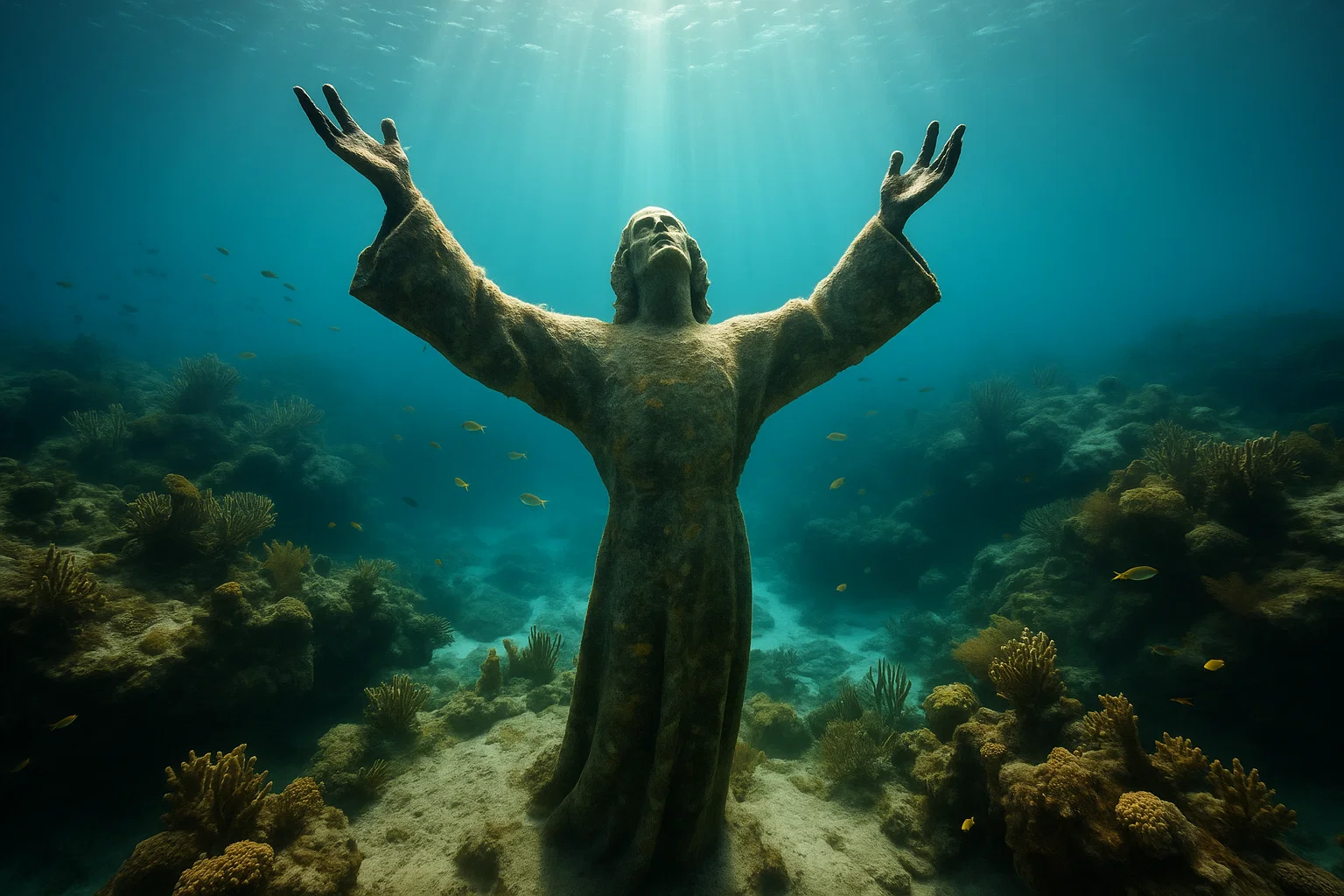
 If you ever visit Key Largo and look beyond the horizon into the clear blue waters, something extraordinary waits beneath the surface a statue of Jesus Christ standing with open arms, reaching upward toward the light. Locals call it Christ of the Abyss. To many, it’s not just a monument it’s a living symbol of peace, faith, and the presence of God in creation itself.
Let’s dive deeper, both literally and spiritually, into why this underwater statue holds such profound meaning and what it whispers to the hearts of those who see it.
The Story Beneath the Waves
The Jesus statue in Key Largo isn’t a random art piece dropped into the ocean. Its story begins in Italy in the 1950s with a sculptor named Guido Galletti. He created the original Il Cristo degli Abissi (Christ of the Abyss) for the waters off Genoa, honoring Dario Gonzatti, the first Italian to die while diving. The statue symbolized not just remembrance, but redemption the belief that even in the depths, Christ’s arms reach toward us.
A second casting was later gifted to the United States. In 1965, it found its home in the waters off Key Largo, Florida, within the John Pennekamp Coral Reef State Park the first undersea park in America. Since then, it has drawn divers, snorkelers, and believers from around the world.
It’s about 8.5 feet tall and stands in roughly 25 feet of water. The bronze figure shows Jesus with his face turned upward, hands raised, as though blessing the sea itself. Over the years, coral has grown along its base and tiny fish often swim around His hands, giving the statue a living, breathing beauty.
Why a Jesus Statue in Key Largo?
People often ask, “Why is there a Jesus statue underwater?” The answer lies in the intersection of faith, art, and nature.
This statue was placed as a message of hope for those who explore the deep. It reminds us that no matter how far we go into the ocean, into our struggles, or into life’s darkest corners Christ meets us there.
Romans 8:39 says, “Neither height nor depth, nor anything else in all creation, will be able to separate us from the love of God in Christ Jesus our Lord.” The statue captures that truth in visual form. It’s a prayer cast in bronze a declaration that God’s presence is not confined to churches or land, but fills all of creation.
For divers who descend into the blue silence, the statue feels like a cathedral beneath the sea. The light refracts through the water, and Jesus’ face seems to glow, inviting reflection and reverence.
The Depths Tell a Story
The Christ of the Abyss in Key Largo sits about 25 feet below the surface deep enough to feel the weight of the ocean, yet shallow enough that sunlight still touches His face.
That depth is symbolic. It mirrors the human experience of faith. Sometimes we live in the shallows, where things are bright and easy. But there are seasons when we find ourselves descending through loss, anxiety, or uncertainty. Down there, in the silence and shadows, we might wonder if God still sees us.
The statue answers that question wordlessly. Jesus stands right there, not above the water, but with us in the deep. His arms aren’t closed they’re open. His head isn’t bowed in despair it’s lifted toward heaven.
Psalm 139:9–10 says, “If I rise on the wings of the dawn, if I settle on the far side of the sea, even there Your hand will guide me, Your right hand will hold me fast.”
Every diver who hovers before that statue experiences a glimpse of that verse made real.
A Place of Prayer Without Words
What’s remarkable about the Key Largo statue is how silent it is. There are no sermons, no hymns, no walls or pews. Just water, light, and the stillness of Christ.
That silence can become a sacred space. Underwater, you hear your own breath and heartbeat the sound of being alive. In that calm, many find themselves praying without even meaning to.
One diver once said, “When I looked at His face, I felt like He was saying, ‘I’ve been waiting for you.’”
Faith has a way of doing that. God finds us in the places we least expect sometimes beneath the surface of our daily routines or under the weight of our worries. The Jesus statue is more than bronze; it’s a mirror of faith that lives quietly, even in the depths.
Creation Reflecting the Creator
The coral reef surrounding the statue is breathtaking. Schools of parrotfish and angelfish swirl around it, sea fans sway like silent worshipers, and shafts of light dance across the sand. Nature itself becomes part of the story.
Romans 1:20 reminds us that “God’s invisible qualities His eternal power and divine nature have been clearly seen, being understood from what has been made.”
Here, that verse feels alive. The reef, the sea, and the statue all speak one language: praise. Even in the deep, creation testifies to the Creator.
It’s as though the ocean itself kneels around Christ’s open arms.
Coordinates of Faith
For those who want to find it, the coordinates of the Jesus statue in Key Largo are roughly 25° 07′ 23″ N, 80° 17′ 38″ W.
But faith isn’t about GPS points. These coordinates are more like a metaphor. They mark a meeting place where human craftsmanship and divine inspiration converge. Where art meets theology, and nature meets reverence.
If you ever make that dive, you’ll notice something subtle: as you descend, the world grows quiet, and light becomes precious. It’s a humbling experience, almost like entering the sanctuary of creation itself.
The Meaning of Open Arms
The statue’s posture arms stretched upward carries its own sermon. It’s an image of surrender, praise, and invitation all at once.
When we raise our hands in worship, it’s usually to acknowledge that we’re small before a vast God. Here, Christ’s raised arms seem to reverse that gesture. He’s the one reaching toward us, saying, “Come back to Me.”
It’s a tender reminder that grace doesn’t wait for us to climb upward it meets us right where we are, even in the deep.
Philippians 2:8–9 says that Christ “humbled Himself by becoming obedient to death even death on a cross. Therefore God exalted Him.” The statue’s upward stance captures that eternal movement from humility to glory, from depth to light.
What Divers Say
Thousands visit each year. Some describe the experience as spiritual, others call it emotional. A few simply say it’s beautiful.
One diver shared, “I’m not religious, but when I saw the statue, I felt peace like I’ve never felt before.”
That’s the power of faith expressed through art it transcends language and denomination. The statue doesn’t demand belief; it invites reflection. Whether someone believes in God or not, they can feel the sacredness of that moment underwater.
It’s not a monument to religion it’s a quiet reminder of love, hope, and the possibility of redemption.
Lessons From the Depth
When you think about it, the underwater Christ tells us three simple truths:
- God is Present Everywhere. Even in the places we least expect under pressure, in silence, or beneath layers of struggle He is there.
- Faith Is About Descent as Much as Ascent. Sometimes you have to go deeper to truly see the light.
- Creation Preaches Without Words. The ocean, like Scripture, speaks of renewal, rhythm, and divine balance.
These truths aren’t meant to stay underwater they’re meant to rise with us.
When divers surface, they carry the image of Christ upward, back into the noise of the world. That’s how faith works too it transforms what we see so that even ordinary life glows with a quiet holiness.
A Symbol Beyond Religion
Interestingly, the Christ of the Abyss has become a symbol not just for Christians, but for environmentalists and artists alike. It stands as a reminder of how humanity and nature can coexist in reverence.
In a world that often feels divided by belief, by borders, by busyness the statue calls for stillness and unity. Its message is simple: peace is possible when we look toward the same light.
The ocean doesn’t care what denomination you belong to. It welcomes everyone the same. That inclusiveness mirrors the heart of Jesus Himself open arms for all.
The Surface and the Soul
Every dive begins with a breath at the surface. You look down, see the blur of the statue far below, and start to descend. The deeper you go, the less you hear, until there’s nothing but your own pulse and the movement of water.
That’s when it hits you faith often feels like this. You leave behind the noise, surrender control, and trust that the One who made the sea also holds your breath, your heart, your life.
Then, suddenly, He appears arms open, face lifted. And even though it’s just bronze and saltwater, something in your soul stirs.
That moment is what believers through centuries have called grace.
What It Means for Us
You don’t have to be in Key Largo to experience what that statue represents. We all have “underwater” seasons times when life feels heavy or unclear.
The Christ of the Abyss reminds us that faith doesn’t erase the deep; it transforms it. Christ meets us there. He sanctifies the silence. He lights up the murky water of our hearts.
When you next feel like you’re sinking, remember: there’s a Savior already waiting in the depths. His arms are open, and His face is turned toward the light.

Dr. Miriam Solano is a pastor and missionary with 18 years of global ministry experience. Her writing inspires spiritual growth and reminds readers that God’s love speaks to every culture and heart.